Olympus Mars Logo Olympus Mars
Home ERC Join us
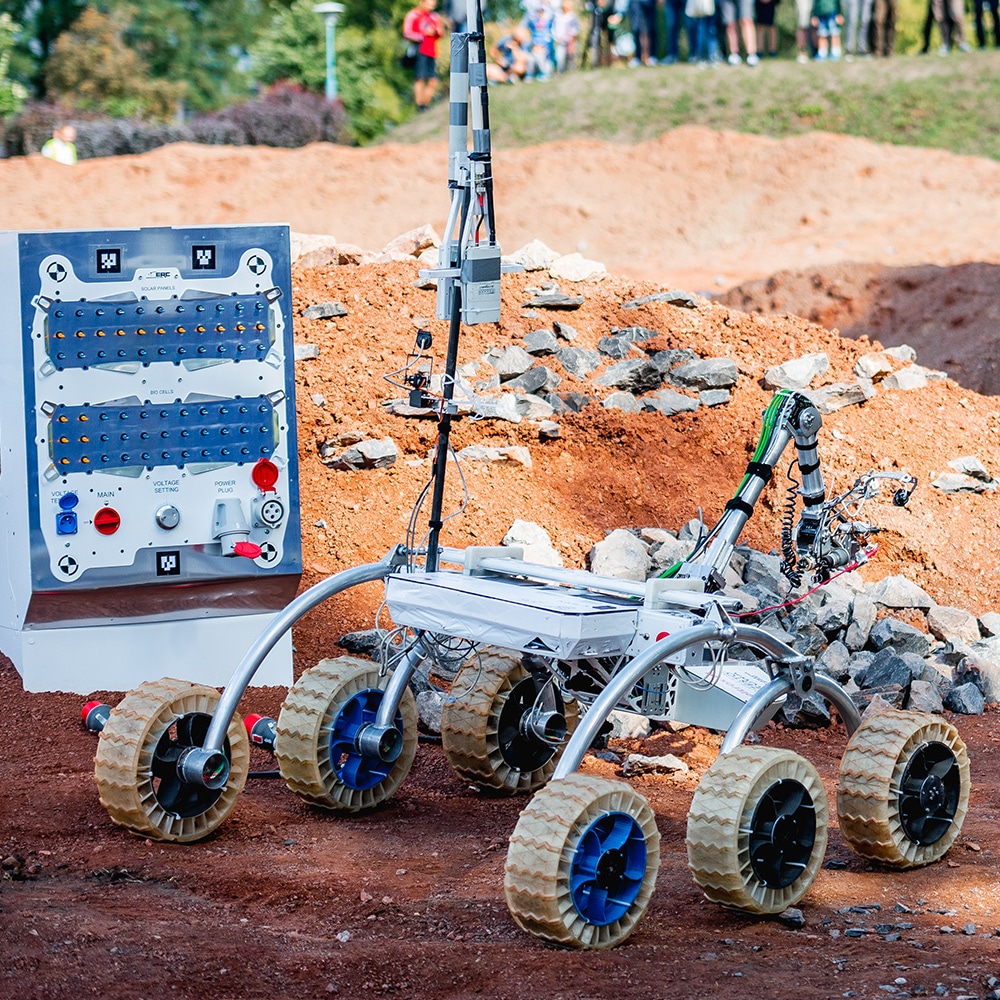
ERC Rover on Mars Yard
ERC Competition
Rover Competition

WHAT IS ERC?

The European Rover Challenge (ERC) is one of the world's most prestigious space robotics competitions where university teams design and build rovers for a Mars-inspired environment. It brings students into the world of planetary exploration through a real engineering challenge, turning space robotics from something distant and theoretical into something they can actually design, build, and test. At the same time, it encourages innovation and the development of new technologies by pushing teams to solve complex engineering problems in creative and practical ways.

At Olympus MARS, we want to be part of that mission by developing an autonomous, reliable, and high-performance rover system capable of tackling the challenges of planetary exploration. For students, that means the chance to build something real, meaningful, and technically ambitious. For partners and sponsors, it means supporting a project that encourages innovation, develops talent, and turns bold ideas into engineering reality.

Mars Rover Space Exploration STEM Mechatronics Automation Robotics Student Competition
100+
Teams International students from universities across the world register for a chance to compete in the ERC finals.
13k+
Competitors Since its first edition, the ERC has welcomed thousands of participants from diverse backgrounds to the Mars Yard in Poland.
200k+
Viewers Over the years, the ERC has become increasingly popular, with hundreds of thousands of people estimated to follow the finals every year.
2014
Established For more than a decade, ERC has brought together brilliant minds from around the world for one of the most exciting robotics spectacles of the year.

Upcoming Finals

Krakow, Poland
4-6 September 2026
3
Days
25
Finalists
1
Winner

ERC TASKS

Tap a task to learn more
Navigation
Master the terrain. The navigation task challenges teams to build a rover that can autonomously move through a Mars-like environment, detect and avoid obstacles, and reach a series of target points with precision and reliability.
Droning
Take exploration into the air. The droning task adds an entirely new dimension to the mission by challenging teams to deploy an autonomous drone that takes off, scans the terrain, identifies probes on the ground, and lands precisely on a designated target area.
Probing
Recover what was left behind. The probing task challenges teams to locate probes in the terrain, pick them up, and bring them back safely, turning the mission into a fast-paced test of mobility, strategy, and precision handling.
Maintenance
Repair the mission. The maintenance task challenges teams to design a highly capable, precise and reliable robotic arm to operate a control panel and execute a complex sequence of repair-style actions.
Surface Sampling
Capture Martian surface. The surface sampling task challenges rovers to recognize target samples, execute a controlled pickup, and manage collected material on board with the precision expected from a real exploration mission.
Deep Sampling
Search beneath the surface. The deep sampling task challenges teams to design a system capable of drilling into the ground, extracting subsurface material, and doing so with the precision and robustness required for a real planetary mission.
Exploration
Turn exploration into science. The exploration task challenges teams to study geological material on a Martian landing site, develop their own hypothesis about the region, and send their rover out to collect the required data to accept or reject their theory.
Astro-Bio
Find extraterrestrial life. The Astro-Bio task challenges teams to study the provided documentation, identify the most promising measurement site for signs of life, retrieve a liquid sample for further analysis, and assess the potential for biological activity based on the data collected.

ERC TIMELINE

1
February
Registration Opens
2
March
Registration Closes
3
April
Preliminary Report Due
4
May
Rover Video Submission
5
June
Finalists Announced
6
July
Final Reports Due
7
September
ERC Finals